
What is K-Style Gutters?
K-Style Gutters is a rain gutter profile with a flat bottom, straight back, and decorative front edge shaped like the letter K. The profile resembles crown molding and commonly appears on modern residential roofs.
Quick Facts About K-Style Gutters
Category
Gutter profile and drainage component
Used for
Collecting roof runoff on residential and light commercial buildings
Measured by
Width, length, slope, outlet size, and downspout capacity
Common confusion
K-style describes shape, not a specific material or installation method
Also called
K-style rain gutters, OGEE gutters
Often discussed with
Gutter Installation, Gutter Replacement
Key Takeaways About K-Style Gutters
- K-style gutters have a flat base and shaped front edge that resembles crown molding.
- Aluminum is common because it is light, corrosion resistant, and available in many colors.
- Gutter slope directs collected water toward downspouts and prevents standing water.
- Five- and six-inch sizes serve many homes. But roof area and rainfall affect sizing.
- K-style gutters are different from half-round gutters, which have a rounded channel.
Understanding K-Style Gutters
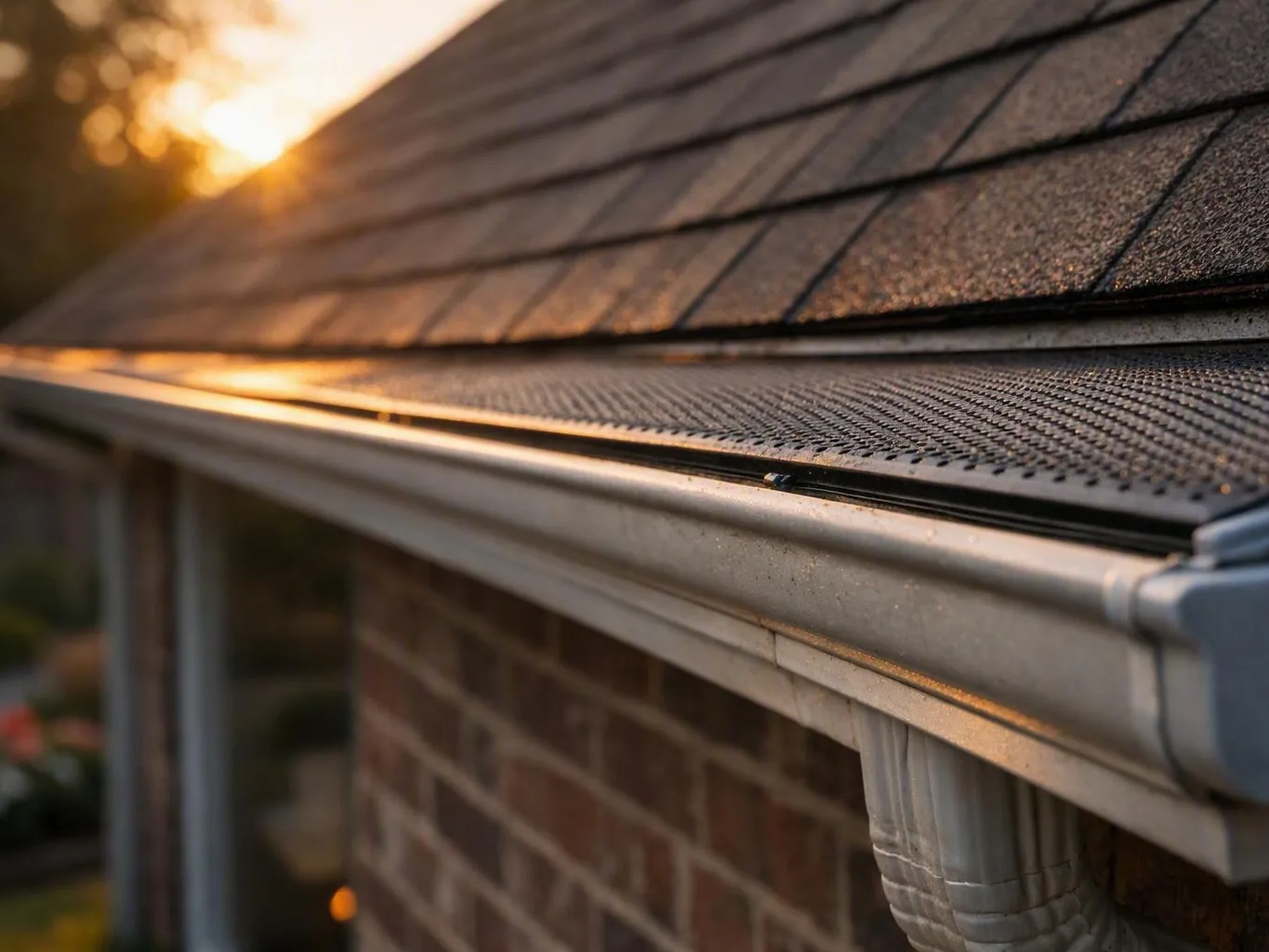
K-style gutters are formed rain channels with a flat bottom, a straight back, and a decorative front edge. The front profile often resembles crown molding. This helps the gutter blend with fascia boards and other exterior trim. The name describes the cross-sectional shape, not the gutter material, color, brand, or installation method.
Related glossary terms: Aluminum Gutters, Downspout, Gutter Hangers.
Most K-style systems use aluminum, although steel, copper, and vinyl options also exist. Aluminum is common on residential buildings because it weighs little and resists rust. K-style gutters usually hold more water than half-round gutters of similar width. Their deeper shape provides more channel volume. Their appearance also suits many contemporary and traditional homes.
How K-Style Gutters Works, Is Measured, or Is Used?
Rain flows from the roof into the gutter channel, then moves along a slight gutter slope toward an outlet. The outlet connects to a downspout, which carries water to a splash block, extension, or drainage system. Installers set the channel high enough to receive runoff. They keep the back edge aligned with the roof edge and fascia.
Gutter size is based on channel width, roof area, roof pitch, and local rainfall intensity. Common residential sizes include five-inch and six-inch K-style gutters. A larger roof plane or steep roof may need greater capacity. Installers also check miter joints, outlet placement, hanger spacing, and end caps. A correctly sized gutter can still leak or overflow if those parts are poorly fitted.
Why K-Style Gutters Matters?

The gutter profile affects both water capacity and exterior appearance. A properly designed gutter system reduces water that reaches siding, doors, windows, and the foundation. It also limits soil erosion near the building. It helps protect landscaping from concentrated roof runoff.
Shape alone doesn't determine performance. A K-style gutter may overflow if the roof area exceeds its capacity. It may also overflow if the channel lacks proper slope or debris blocks the outlet. Gutter guards can reduce leaf entry, but guards don't correct poor pitch, undersized downspouts, damaged fascia, or blocked underground drainage.
When K-Style Gutters Matters Most?
K-style gutters deserve close review during new installation, roof replacement, or gutter replacement. Changes to the roof can alter runoff volume and outlet locations. Fascia damage can weaken the points that support gutter hangers. A preinstallation inspection should identify loose trim, peeling paint, sagging sections, leaking seams, and areas where water already collects.
Local weather and site conditions also affect design decisions. In Memphis, heavy rain events, mature trees, and clay-rich soil can increase the need for well-placed downspouts and controlled discharge. Check that water leaves the foundation area. Check that each downspout has a clear route. Check that the selected material matches the building's maintenance needs and appearance.
How to Evaluate K-Style Gutters?
- Confirm the gutter width matches roof area, roof pitch, and expected rainfall for each roof section.
- Check that the channel has a continuous slope toward each outlet and no low spots that hold water.
- Inspect fascia boards and hanger attachment points for rot, cracks, looseness, or water staining.
- Verify downspout outlets, extensions, and discharge points can move water away from the foundation.
- Look for sealed miter joints, secure end caps, aligned sections, and clean outlet openings.
Related Concepts Compared
K-Style Gutters vs. Half-Round Gutters
Half-round gutters have a curved, semicircular channel with a rounded bottom. K-style gutters have a flatter base and shaped front edge, so the two profiles differ in appearance, capacity, and compatible hangers.
K-Style Gutters vs. Box Gutters
Box gutters are larger, built-in drainage channels often integrated into a roof edge or parapet. K-style gutters are exposed, attached to the exterior fascia, and commonly used on residential buildings.
K-Style Gutters vs. Aluminum Gutters
Aluminum describes the gutter material. K-style describes the gutter shape, so an aluminum gutter can be K-style, half-round, or another profile.
Expert Note
A K-style gutter should not be selected by appearance alone. Roof drainage area, outlet spacing, downspout size, fascia condition, and discharge location determine whether the system will manage runoff reliably.
Common Mistakes or Myths About K-Style Gutters
- Treating K-style as a material instead of a gutter profile.
- Choosing five-inch gutters without reviewing roof area and rainfall flow.
- Installing gutters on rotted fascia without repairing the supporting wood.
- Assuming gutter guards eliminate the need for inspections and cleaning.
- Discharging downspouts beside the foundation instead of directing water to a safe outlet.
K-Style Gutters in Practice: A Real-World Example
A two-story Memphis home has a steep roof, several mature trees, and five-inch K-style gutters that overflow during heavy rain. An evaluation finds adequate channel width but clogged outlets and too few downspouts. Cleaning the system and improving outlet capacity may solve the overflow without replacing every gutter section.
Sources & Further Reading on K-Style Gutters
Related Services
Related Terms
Aluminum Gutters
Aluminum Gutters is a rainwater drainage system made from formed aluminum channels and downspouts. The system…
Downspout
Downspout is a vertical pipe that carries water from a gutter to the ground or a…
Gutter Hangers
Gutter Hangers are hardware pieces that attach a rain gutter to a building’s fascia, rafter tails…
Gutter Slope
Gutter Slope is the slight angle that directs water through a gutter toward a downspout. Installers…
All Pro Roofing and Gutters
Have Questions About K-Style Gutters?
Contact All Pro Roofing and Gutters for practical guidance on K-Style Gutters and related gutter installation and gutter guards work in Memphis.